Across China: AI-powered virtual technologies elevate Chinese filmmaking via grand realism, efficiency

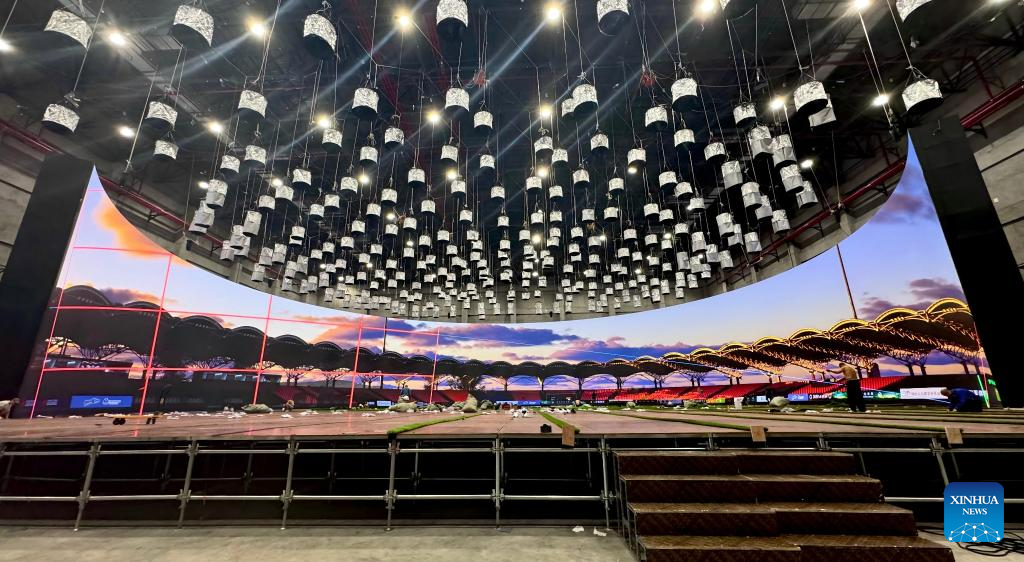
This photo taken on Nov. 26, 2025 shows a virtual scene of the main stadium of Hong Kong's Kai Tak Sports Park at Versatile Media's AI virtual film base in Deqing, east China's Zhejiang Province.(Versatile Media/Handout via Xinhua)
HANGZHOU, Feb. 22 (Xinhua) -- Inside a studio featuring the world's largest single-structure LED at an AI virtual film base in Deqing, east China's Zhejiang Province, a Hong Kong football-themed film was being made.
A 50-meter-diameter curved screen rendered the main stadium of Hong Kong's Kai Tak Sports Park in real-time, with tens of thousands of digital spectators cheering as goals were scored, creating an immersive experience akin to being in the real stadium.
Using advanced artificial intelligence (AI) and virtual production technologies, this film base enables crews to retrieve different scenes on screen and blend virtual and physical elements to recreate such iconic landscapes digitally, according to the facility owner Versatile Media, a virtual production company based in Hangzhou, capital of Zhejiang Province.
"Shooting on location is difficult and expensive, especially for long periods," noted Niu Cong, a project coordinator with Versatile Media. "The virtual studio, with its ample space and systemic advantages, fulfills creative needs. That's why we bring a whole stadium indoors."
More filmmakers are now turning to AI virtual production, according to Niu.
The Deqing facility, notably, reflects a broader push to integrate AI into filmmaking. Across China, studios are adopting AI and other digital tools.
"For a period drama, we used to spend three months building sets, only to later tear down 80 percent of them," Niu said. "Now, virtual assets stay in digital libraries and can be reused. Lighting and coordination are also easier."
Since its official opening in July 2025, the Deqing film facility has hosted over 30 film projects. Its advanced virtual filming system has quickly made this new base a sought-after industry hub. In 2026 alone, nearly 10 companies have signed contracts to settle there.
The base is also moving into AI-generated short dramas. It has 89 such projects planned for this year, using its own AI platform for these endeavors.
In Yangzhou, east China's Jiangsu Province, meanwhile, the local film and television base has built a large constant-temperature water scene filming studio. Utilizing digital intelligence technologies, it creates realistic giant waves for films, offering a one-stop solution for the shooting of water scenes.
The studio can simulate more than 200 wave types via computer, with a width of 35 meters and wave height up to 3 meters. Underwater shooting depth reaches 11 meters. Water can also be heated to 32 degrees Celsius in 24 hours, while all water conditions can be remotely adjusted by operators.
This studio has served multiple film productions, providing realistic water scenes without the need for post-production visual effects. It also deploys underwater robots to assist with filming.
In southwest China's Chongqing Municipality, a digital set workshop uses an automated platform to swap scenes via a mouse click. Switching takes less than a second, boosting shooting efficiency by 55 percent and cutting large-scale set costs by 90 percent.
These technological shifts are fundamentally changing how films are made in China.
"The application of AI technology is not just an innovation at the tool level. It also brings a revolution to the filmmaking workflow," said Wang Shu with the China Science Writers Association.
"AI-powered film and TV creation will further propel the industry toward greater efficiency and intelligence," Wang added. ■


